Book Review - The Chimp Paradox by Prof Steve Peters
Giving people to stop being at war with their emotions
BOOK REVIEW
Simon
3/10/20252 min read
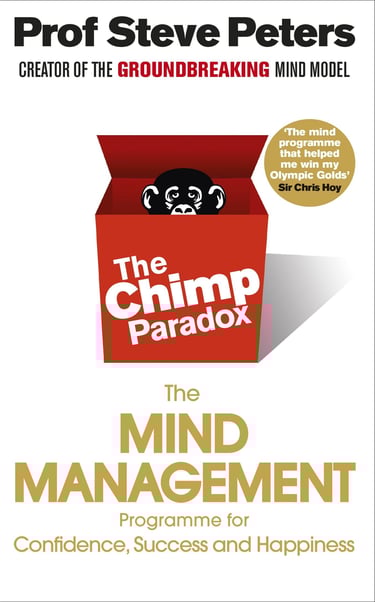
The Chimp Paradox – Prof Steve Peters
Synopsis
The Chimp Paradox by Steve Peters is a practical framework for understanding and managing the internal conflicts that drive stress, self-sabotage, and underperformance. Peters presents the mind as a system made up of three parts the Chimp (emotional brain), the Human (logical brain), and the Computer (habits and beliefs). When the Chimp takes control, behaviour becomes reactive and irrational. The book’s central promise is simple: you cannot remove the Chimp, but you can manage it.
Purpose / Intent / Story
Peters wrote the book to translate neuroscience into everyday language that people can actually use. Drawing on his work with elite athletes and performers, he noticed that intelligence alone does not guarantee good decisions under pressure. Emotional reactions hijack behaviour. Rather than framing this as weakness or lack of discipline, Peters reframes it as biology. The goal is not self-control through suppression, but self-management through understanding.
Detailed Key Summary
1. The Three-Part Mind Model
The Chimp: Emotional, impulsive, powerful, and quick. It reacts to perceived threats and rewards, often irrationally.
The Human: Rational, calm, values-driven, and slower. This is the part that plans, reflects, and chooses long-term outcomes.
The Computer: Stores habits, beliefs, and automatic responses. It can work for or against you depending on what is programmed into it.
Most problems occur when the Chimp acts first and the Human arrives too late.
2. The Chimp Is Not You
A core insight is separating identity from emotion. “I am not my Chimp.” This creates psychological distance, allowing you to observe emotional reactions instead of being consumed by them. Once separated, responsibility returns to the Human to manage outcomes rather than justify reactions.
3. Managing the Chimp (Not Fighting It)
Trying to argue with the Chimp rarely works. Instead, Peters recommends:
Letting the Chimp vent (safely)
Soothing it with reassurance or physical actions
Redirecting it through routine and structure
Only once the Chimp is calm can logic take over.
4. Programming the Computer
Long-term change comes from updating the Computer. This means consciously installing helpful beliefs, habits, and responses so that you do not need to think in high-pressure moments. Discipline becomes design.
5. Stress, Confidence, and Success
Stress is framed as a mismatch between perception and reality. Confidence is not bravado but trust in your systems. Success depends less on motivation and more on repeatable processes that keep the Chimp contained.
Reviews and Accolades / References from Others
Widely adopted across elite sport including British Cycling, Premier League football, and Olympic programmes.
Praised for making psychology accessible without dumbing it down.
Frequently recommended in leadership, performance coaching, and wellbeing programmes.
Endorsed by athletes, executives, and educators as a practical alternative to purely motivational thinking.
Final Insight
The lasting value of The Chimp Paradox is not the metaphor itself but the permission it gives people to stop being at war with their emotions. Once you accept that emotional reactions are normal and predictable, you can design systems that keep you effective even when pressure is high. This is not about becoming calmer. It is about becoming consistent.
© 2024. All rights reserved.
Target Coaching, 73 Shelton Street, London, WC2H 9JQ