Book Review - Surrounded by Idiots by Thomas Erikson
Praised for its clarity, particularly for improving workplace communication
BOOK REVIEW
Simon
1/24/20242 min read
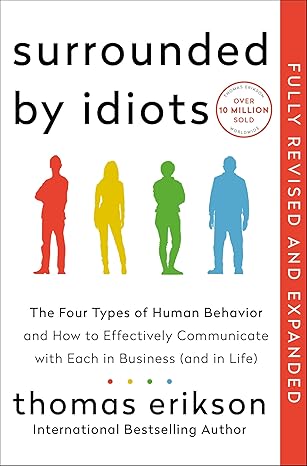
Surrounded by Idiots — Thomas Erikson
1. Synopsis
Surrounded by Idiots is a popular communication and self awareness book that explains why people so often misunderstand each other at work and in life. Erikson introduces a simple four type behavioural framework, colour coded as Red, Yellow, Green, and Blue, to help readers recognise different communication styles. The core promise is straightforward: when you understand how others think, speak, and decide, everyday interactions become easier and far less frustrating.
2. Purpose / Intent / Story
Erikson’s intent is practical rather than academic. The book is written for everyday readers who feel exasperated by colleagues, managers, clients, or even family members who “just do not get it.” Drawing on his experience as a leadership coach and trainer, Erikson aims to normalise difference rather than judge it. The title is deliberately provocative, but the underlying message is that people are not idiots, they are simply operating from a different behavioural lens.
The story throughout the book is one of relief: once you stop assuming others think like you do, communication becomes a skill you can adapt rather than a battle you keep losing.
3. Detailed Key Summary
At the heart of the book is a simplified behavioural model built around four dominant styles:
Red: Direct, decisive, fast paced, results focused. Reds value action and efficiency and can appear blunt or impatient.
Yellow: Enthusiastic, social, persuasive, idea driven. Yellows thrive on interaction and optimism but may struggle with detail or follow through.
Green: Calm, supportive, patient, relationship focused. Greens value harmony and stability and may resist rapid change or confrontation.
Blue: Analytical, cautious, structured, detail oriented. Blues prioritise accuracy and logic and can appear critical or slow to decide.
Erikson stresses that no style is better than another. Problems arise when people communicate in their own preferred style and expect others to automatically adapt. A Red may push for quick decisions, frustrating a Blue who wants more data. A Yellow’s enthusiasm may overwhelm a Green who prefers steady, predictable progress.
The practical value of the book lies in its emphasis on adaptation. Erikson repeatedly encourages readers to adjust their communication style depending on who they are dealing with, whether that means slowing down, adding structure, softening tone, or focusing more on people than tasks. While the model is intentionally simplified, it serves as a memorable shorthand for recognising behavioural differences and reducing friction.
4. Reviews and Accolades / References from Others
The book has been an international bestseller, translated into dozens of languages, and widely adopted in corporate training and leadership development programmes. Many readers praise its clarity, accessibility, and immediate usefulness, particularly for improving workplace communication.
Critics, especially those with a psychology background, often note that the model is an oversimplification and lacks scientific depth. However, even sceptical reviewers tend to acknowledge its strength as a practical communication tool rather than a diagnostic system. Its enduring popularity suggests it resonates strongly with managers and teams looking for simple ways to improve understanding and collaboration.
© 2024. All rights reserved.
Target Coaching, 73 Shelton Street, London, WC2H 9JQ